
PROJECT / 02
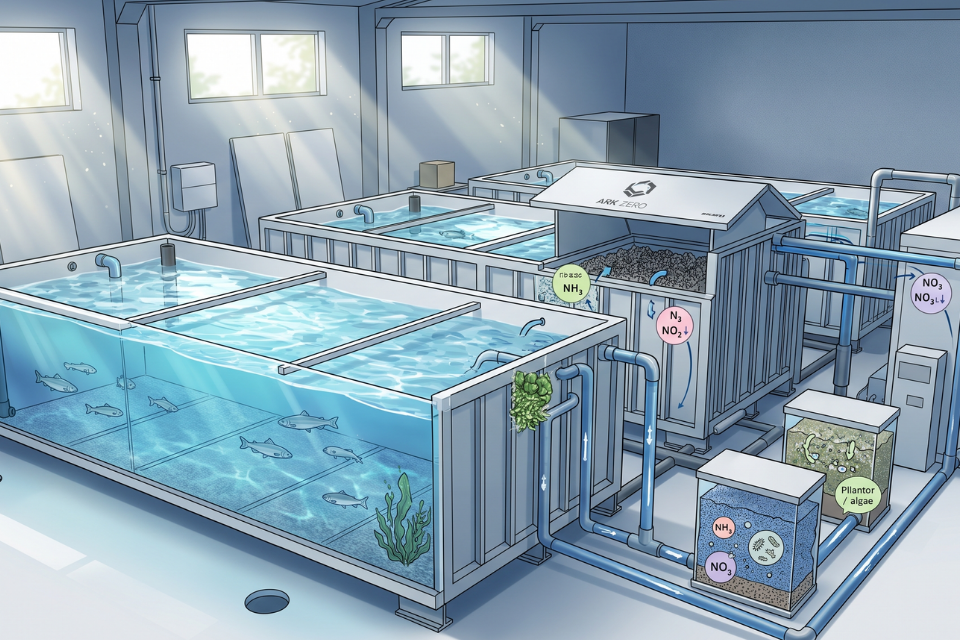
Project for Optimizing Nitrogen Cycles in Closed Recirculating Aquaculture Systems
Nitrogen Cycles × Distributed Aquaculture
Optimize nitrogen flows and make aquaculture possible anywhere.
By combining AI, automation, and cross-disciplinary expertise, we will develop a next-generation modular RAS that optimizes water quality and cost.
CONTEXT
Make nitrogen cycles the foundation of new aquaculture
High capital and operating costs are major barriers to closed recirculating aquaculture systems. The cost of treating ammonia and nitrate directly affects stocking density, energy use, and production costs.
WHAT WE DO
Implementation
Modularize the hardware
Build infrastructure that can start small.
We optimize modular equipment design to reduce cost per unit of water and create a foundation for distributed systems.
- Optimize equipment design
- Reduce cost per water volume
- Support small distributed sites
Optimize water quality with AI
Turn water-quality data into operating decisions.
We collect water-quality and feeding data and use AI control to improve nitrification and denitrification performance.
- Measure ammonia and nitrate
- Connect feeding and water data
- Target a 10–20% filtration improvement
Minimize energy from mass balance
Design pump power from nitrogen flows.
We calculate optimal circulation flow from nitrogen generation and filtration volumes to suppress unnecessary electricity use.
- Track nitrogen generation and filtration
- Calculate optimal circulation
- Reduce operating electricity costs
Save labor with robotics
Enable stable operation with a small team.
We integrate automatic feeding, transport, sorting, and cleaning into the system to reduce workload and improve productivity.
- Automatic feeding and sorting
- Integrated cleaning mechanisms
- Higher labor productivity
Connect expertise to implementation
Make research and field operations one ecosystem.
We combine ecology, microbiology, and water engineering with municipalities, companies, and financial institutions to design a deployable model.
- Bridge universities and the field
- Partner with municipalities and finance
- Package an aquaculture OS and infrastructure
FIELD & PARTNERS
Start small and meet global protein demand
We will scale the validated modular RAS as distributed infrastructure that gives the sea room to recover while supporting reliable seafood production.
- Japan | Development and validation of modular RAS
- Middle East and Southeast Asia | High-value fish production
- Distributed sites | Land-based production that gives the sea room to recover
PROJECT TEAM
Bring aquaculture and cross-disciplinary strengths together
AQUACULTURE
ARK Inc.
Develops and validates the next-generation modular RAS.PROJECT ORGANIZER
Leave a Nest Co., Ltd.
Coordinates challenge definition, research bridging, and ecosystem design.OPEN INNOVATION